Open today from 9h00 to 19h00 Visit today
 The museum The souvenir gardens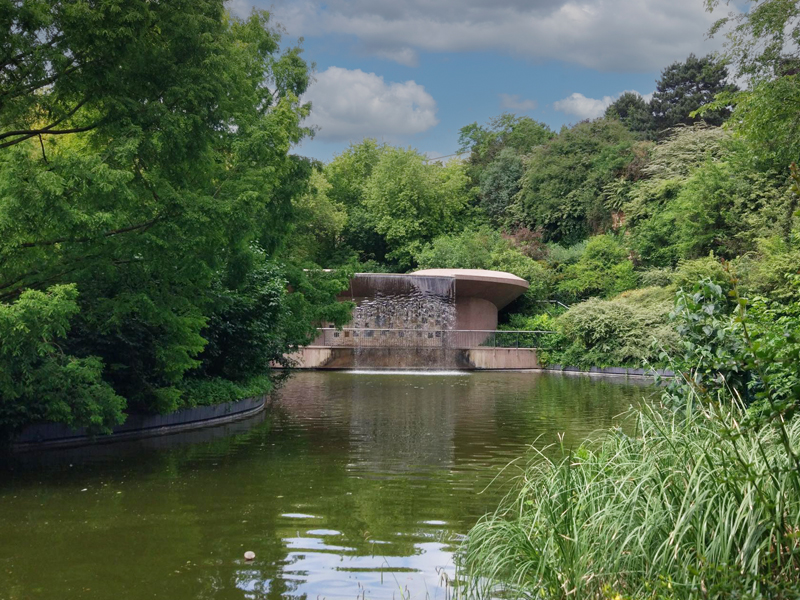
In 1994, to mark 50 years since the liberation of Europe, the American Garden was officially opened…
With a fountain symbolizing life at the center, plaques of the fifty American states have been erected nearby.
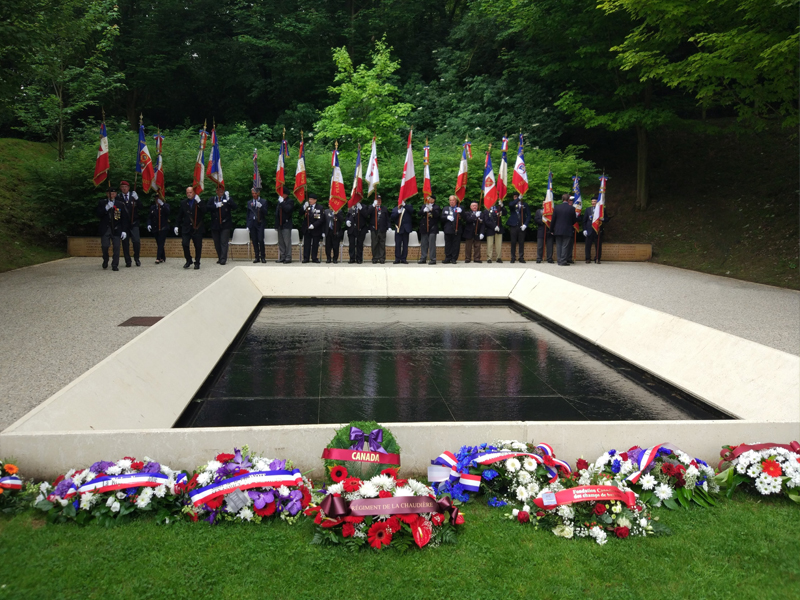
In 1995, it was the Canadian Support Committee’s turn to create its own garden…
Designed by twelve students of architecture from the universities of Montreal and Ottawa, the Canadian Garden encourages reflection.
The low wall lists the name of the 122 Normandy communes liberated by Canadian soldiers. The black granite slab is inscribed with Virgil’s words: “Nulla dies umquam memori vos eximet aevo” (no day will ever erase you from the memory of time).
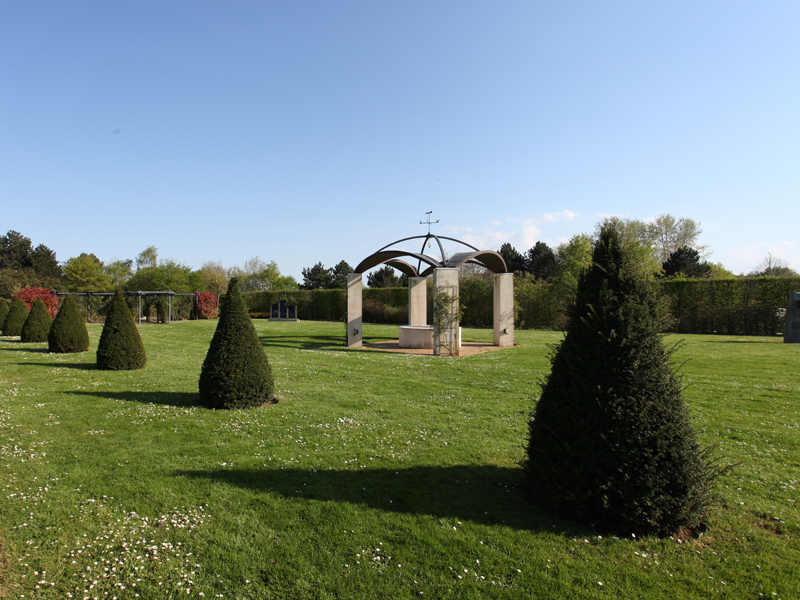
In 2004, Prince Charles inaugurated the British Garden…
This Garden was designed and built on behalf of the British Friends of Normandy with the help of the City of Caen.
Various sculptures evoking the participation of the various forces in the conflict: the Royal Air force, the Royal Navy and the 15 British divisions are represented by cypress trees planted alongside a colonnade in bloom.
The entrance pergola is in the form of a celtic cross to mark the involvement of the Irish regiments. The Temple of Spirits is the center piece in memory of those who lost their lives. The Peace Garden which is for quiet contemplation is entered through a conifer arch.
You might also like

4,6
23 021 avis
We visited as a school group and had a guided tour by Oliver. He was masterful in walking us through the museum and teaching our group about WWII. If you can, get a guided tour by Oliver – he made the museum the best it could be.
Alexandra was awesome. She was incredibly knowledgeable and answered all our questions. She shared insights and stories we had not heard before. We highly recommend booking a tour of Caen with Legacy-Roads Guided Tours
Booked a full day tour of Normandy – Cemetery – St Mere. Oliver our tour guide was excellent. He was informative, knowledgeable, and enthusiastic. As an avid reader of WW2 military history I cannot imagine trying to navigate the Normandy area without going on a tour. I am sure all of the tour guides are great, however, Oliver was outstanding – highly recommend. The format of the tour was well planned – Cemetery and landings, lunch at a nice local bistro, then further sites. Oliver was able to identify through just reading books. The Caen Memorial Museum was very good as well.
It was a trip far more than expected. A good chance to gaze upon the bravery of American soldiers on D-Day on those particular historic spots. I was super lucky to travel by myself along with the tour guide Mario and our driver Alain. Mario is a super enthusiastic guide prepared detailed history facts about the landing day, and always ready to any possible questions – also a patient teacher to a non-French-speaking tourist like me. Driver Alain, humorous as well, guaranteed a smooth landing along the shore for the whole day, and was willing to slow down at any interesting spot. As I mentioned, this guided tour is especially suitable for those traveling without cars or who want to witness most of the prestigious spots in a single day. It provides the best initial impression to those looking for WW2 history in Normandy.
Oliver did a outstanding job. An unplanned incident where a little girl ran up to us in the middle of the beach, asked if I was a veteran and presented me with a veterans medal, left all of us in tears. Later, Oliver asked if I could be part of the Taps lowering of the flag, the request was granted on this Memorial Day. It was a very special day for this US Army veteran. I’m glad I followed my American Legion Commander’s advice and wore my Legion hat. The beach and cemetery tour was sobering, reflective and meaningful. Thank you.
I had a wonderful D-Day tour with Andrea and Allan. They were friendly, knowledgeable, prompt and accommodating. Great full day tour of all the main D-Day sites. And the Memorial the next day was really good as well.
Mémorial de Caen
We firmly believe that the internet should be available and accessible to anyone, and are committed to providing a website that is accessible to the widest possible audience, regardless of circumstance and ability.
To fulfill this, we aim to adhere as strictly as possible to the World Wide Web Consortium’s (W3C) Web Content Accessibility Guidelines 2.1 (WCAG 2.1) at the AA level. These guidelines explain how to make web content accessible to people with a wide array of disabilities. Complying with those guidelines helps us ensure that the website is accessible to all people: blind people, people with motor impairments, visual impairment, cognitive disabilities, and more.
This website utilizes various technologies that are meant to make it as accessible as possible at all times. We utilize an accessibility interface that allows persons with specific disabilities to adjust the website’s UI (user interface) and design it to their personal needs.
Additionally, the website utilizes an AI-based application that runs in the background and optimizes its accessibility level constantly. This application remediates the website’s HTML, adapts Its functionality and behavior for screen-readers used by the blind users, and for keyboard functions used by individuals with motor impairments.
If you’ve found a malfunction or have ideas for improvement, we’ll be happy to hear from you. You can reach out to the website’s operators by using the following email
Our website implements the ARIA attributes (Accessible Rich Internet Applications) technique, alongside various different behavioral changes, to ensure blind users visiting with screen-readers are able to read, comprehend, and enjoy the website’s functions. As soon as a user with a screen-reader enters your site, they immediately receive a prompt to enter the Screen-Reader Profile so they can browse and operate your site effectively. Here’s how our website covers some of the most important screen-reader requirements, alongside console screenshots of code examples:
Screen-reader optimization: we run a background process that learns the website’s components from top to bottom, to ensure ongoing compliance even when updating the website. In this process, we provide screen-readers with meaningful data using the ARIA set of attributes. For example, we provide accurate form labels; descriptions for actionable icons (social media icons, search icons, cart icons, etc.); validation guidance for form inputs; element roles such as buttons, menus, modal dialogues (popups), and others. Additionally, the background process scans all of the website’s images and provides an accurate and meaningful image-object-recognition-based description as an ALT (alternate text) tag for images that are not described. It will also extract texts that are embedded within the image, using an OCR (optical character recognition) technology. To turn on screen-reader adjustments at any time, users need only to press the Alt+1 keyboard combination. Screen-reader users also get automatic announcements to turn the Screen-reader mode on as soon as they enter the website.
These adjustments are compatible with all popular screen readers, including JAWS and NVDA.
Keyboard navigation optimization: The background process also adjusts the website’s HTML, and adds various behaviors using JavaScript code to make the website operable by the keyboard. This includes the ability to navigate the website using the Tab and Shift+Tab keys, operate dropdowns with the arrow keys, close them with Esc, trigger buttons and links using the Enter key, navigate between radio and checkbox elements using the arrow keys, and fill them in with the Spacebar or Enter key.Additionally, keyboard users will find quick-navigation and content-skip menus, available at any time by clicking Alt+1, or as the first elements of the site while navigating with the keyboard. The background process also handles triggered popups by moving the keyboard focus towards them as soon as they appear, and not allow the focus drift outside of it.
Users can also use shortcuts such as “M” (menus), “H” (headings), “F” (forms), “B” (buttons), and “G” (graphics) to jump to specific elements.
We aim to support the widest array of browsers and assistive technologies as possible, so our users can choose the best fitting tools for them, with as few limitations as possible. Therefore, we have worked very hard to be able to support all major systems that comprise over 95% of the user market share including Google Chrome, Mozilla Firefox, Apple Safari, Opera and Microsoft Edge, JAWS and NVDA (screen readers), both for Windows and for MAC users.
Despite our very best efforts to allow anybody to adjust the website to their needs, there may still be pages or sections that are not fully accessible, are in the process of becoming accessible, or are lacking an adequate technological solution to make them accessible. Still, we are continually improving our accessibility, adding, updating and improving its options and features, and developing and adopting new technologies. All this is meant to reach the optimal level of accessibility, following technological advancements. For any assistance, please reach out to