Open today from 9h00 to 19h00 Visit today
In 1944, major Soviet offensives in the east and the Normandy campaign in the west led to the defeat of Nazi Germany.
France was liberated between August and September 1944, while the rest of Europe was freed over the following 18 months.
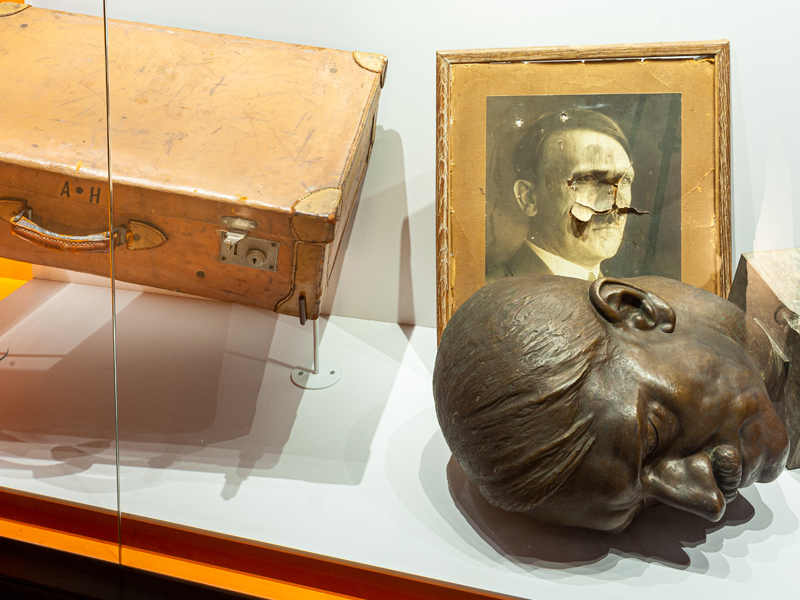
Germany was invaded from both east and west in March 1945.
After Hitler’s suicide on April 30, 1945, the Third Reich collapsed.
In the Pacific, U.S. forces had gained the advantage after Midway (1942), capturing Iwo Jima and Okinawa. Japan became the ultimate goal and President Truman authorized the use of atomic bombs:
Japan surrendered on September 2, 1945.
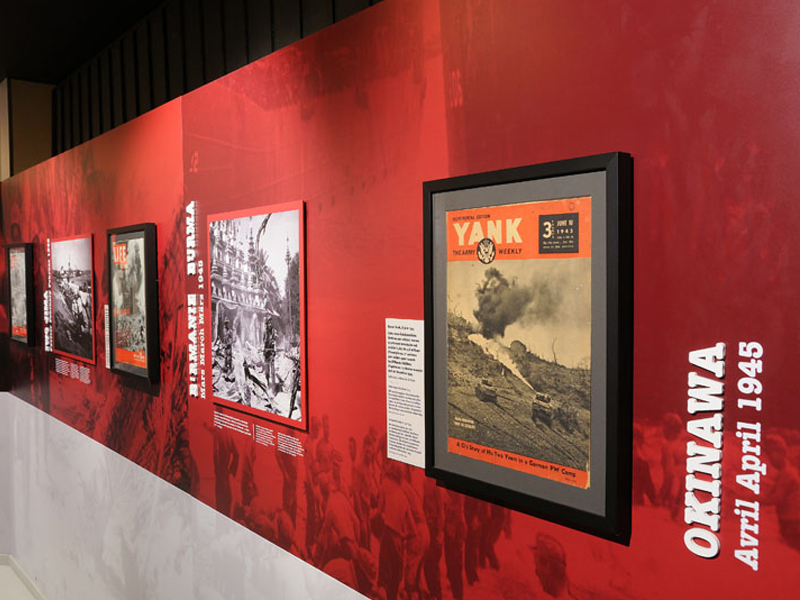
The Americans advanced in the Pacific and the Far East. They dropped atomic bombs on the cities of Hiroshima and Nagasaki.
In January 1945, the Allied armies waged an all-out war of attrition against the Japanese troops in the Pacific and the Far East. The Philippines, New Guinea, and Burma were reconquered. Continuing their advance on Japan, the American troops took Iwo Jima and Okinawa, two victories that brought the Japanese archipelago within range of Allied fire.
For political and military reasons, President Truman decided to use the atomic bomb despite negotiations in progress with the Japanese government. On August 6 and 9, two A bombs were dropped on Hiroshima and Nagasaki. At the same time, Moscow declared war on Tokyo and attacked Manchuria.
On August 15, Emperor Hirohito of Japan asked his people to “accept the unacceptable”; the act of capitulation was signed on September 2 aboard the American battleship Missouri.
During this world war, violence reached a climax. The strategy of terror, the continual discovery of mass graves, the horror of the concentration camps, and the growing awareness of the genocide gave rise to deep and lasting violence, as well as an intense moral shock. The industry of death and fears of a nuclear apocalypse waylaid hopes of continued scientific progress.
Total war on a global scale had profoundly changed the global situation. The most murderous act of carnage known to history provoked such trauma that the Allies brought the Axis leaders before international courts. The determination to build a new world order to ensure sustainable peace led to the creation of the United Nations (UN) in June 1945.
You might also like

4,6
23 149 avis