Open today from 9h00 to 19h00 Visit today
Berlin at the heart of the Cold War

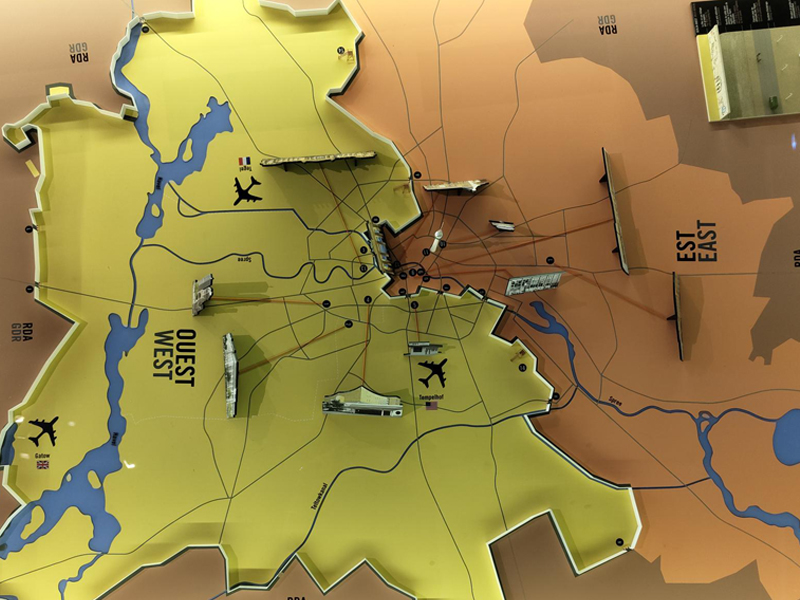
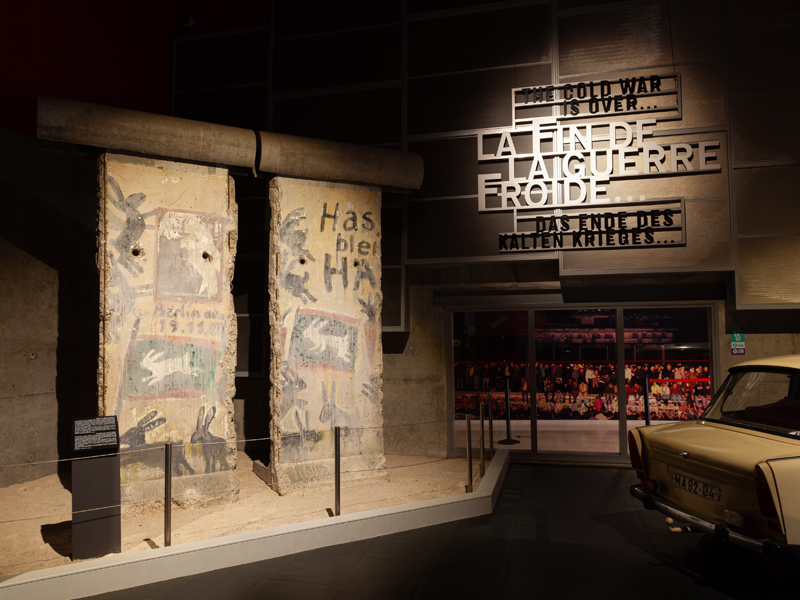
Divided into four zones of occupation in 1945, the city became a major issue for the Americans and the Soviets during the Cold War. Berlin has become a symbol of the Cold War, an emblem of East-West antagonism. This exhibition space, designed around sections of the graffiti-strewn wall, displays objects and films that describe life before and after the fall of the Berlin Wall.

From occupied Germany to divided Germany

The division of Berlin into two zones of influence, from the end of the World War II until the fall of the Berlin Wall in 1989, is without doubt one of the most remarkable symbols of the Cold War.

As soon as the Second World War was over, Germany entered a period of East-West antagonism. The simultaneous defeat of Germany by Soviet and Anglo-American troops, who linked up at Torgau in April 1945, caused the division of Germany during the Cold War.

Cold and hunger were a constant torment to the city’s people. The United States’ Marshall Plan brought an end to these difficulties, but heightened the division brought about by the occupied sectors: the unity of Berlin was but a memory. In Europe, the occupied zones gradually chose their side and two ideological blocs were formed.
Surveillance, escape and crossing

More than 230 people were shot dead by the Vopos (East German security forces) between 1961 and 1989, as they tried to flee “to the other side of the wall”.

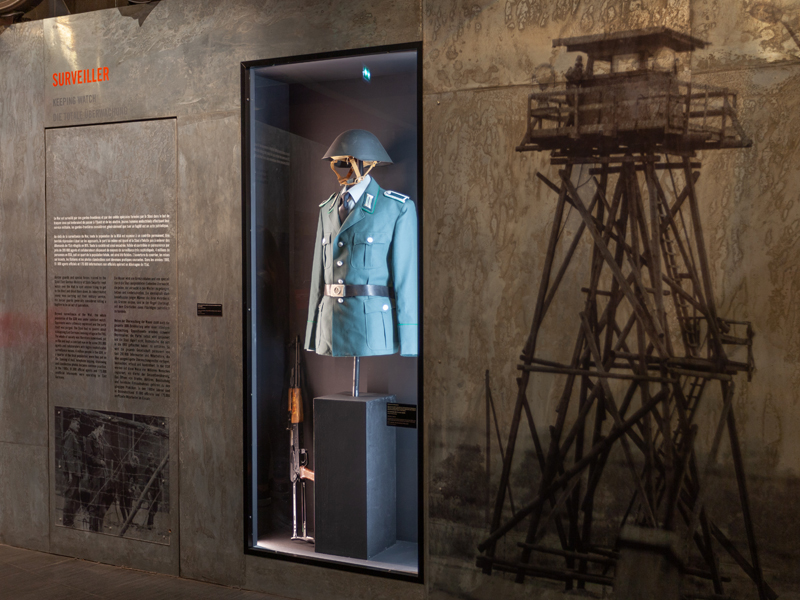
The “wall system” was closely guarded by GDR soldiers, either from their observation towers or during patrols in military vehicles. Before taking position, these young men underwent extremely strict, even brutal, training. They were ordered to shout a warning then shoot at any fugitive. Surveillance was not limited to the wall, however. The entire East German society was spied on.

Tens of thousands of East Germans tried to escape to “the other side of the wall”, despite the huge risk. Escape attempts came in every form imaginable: digging tunnels, fleeing on a boat (in places the wall was a river border), making hiding-places in the trunks of cars, and even crossing in a hot air balloon.
Fall of the Berlin Wall

The year 1989 saw the dismantling of the Soviet bloc. After the drawing back of the iron curtain in Hungary, the fall of the Berlin Wall opened the door to German reunification.

During the night of November 9 to 10, 1989, the Berlin Wall, after ripping the city in two and separating families for 38 years, fell at last under popular pressure. The two sections of the Wall presented in this room give you an idea of the proportions: at the top (3.60 m) there is a pipe in cement to prevent all escape attempts using grappling hooks. Painted from the East shortly after the fall of the Wall by the artist Manfred Butzman, these concrete sections were saved during the dismantling. The artist depicted rabbits, very present in the no man’s land of the Wall system, to symbolize the fate of the fugitives (“get shot at like rabbits”) and more generally as a symbol of freedom and peace. The expression “Hase bleibt Hase”, “Once a Rabbit always a Rabbit”, advocates a peaceful revolution.

Save time, purchase your tickets online now

You might also like

They lived
the experience

Google reviews

4,6

20 710 avis

What a great experience - Legacy Roads

Having a small group to tour with, is so much better than a large bus. Our guide Oliver was a native English speaker and very knowledgeable about history of the region and World War II. Because our group already had a base knowledge of World War II he quickly adapted and tailored the tour so we get the best experience. Lunch was included and delicious!

Excellent tour, excellent tour guide, must do if you only have one day in the area

This was a fantastic tour! The memorial museum was excellent, the movie of the landing very impactful. We could enter the museum whenever we wanted before the van tour so we had lots of time to look around at our own pace. The visit to Pointe du Hoc, Omaha Beach and the American Cemetery was great, moving, enlightening. Our guide was Mario – he was wonderful!!! Extremely knowledgeable, has a great sense of humor and excellent English, can’t recommend him enough! He gave us so much information and answered all our questions – some of us had been to the sites before and we still learned so much more from him. I highly recommend this tour if you only have one day to see the most important US sites of the WWII landings.

William R– United States

As an American wanting to see the American memorial war site as a family, we were pleased to find the tour guide 100% knowledgeable and almost every question we had. Questions were needing to be answered with lack of info prior to the tour, beginning solely based on inability to figure out where to park and meet. Anna, is by far the best tour guide this company has and I would recommend her 2 million times over as well as the driver she worked with. The wealth of knowledge she had, the patients she showed, but the ability to adapt to every individual tourist and her having the ability to professionally handle multiple tourists conversations at the same time and adapting with a New York old woman who could not stop speaking as well as young children at the age of ten, The tour guide guides had every thing that could have been asked, anticipated and ready to be taken care of at the drop of a hat. Flawless, beautiful tour along with a perfect day in Normandy. Always ask FOR ANNA!!!!

Jody– United States

Anna our guide was wonderful and did an excellent job explaining the historical background, planning , decisions and difficulties of the d-day invasion. The d-day beaches, the landing sites on June 6, 1944, and the American cemetery are part of American history, it was very meaningful to visit. Peter our driver was terrific too, I would highly recommend this trip.